Combating antibiotic resistance
Feb. 2019Health in All Policies
Resistent. There is a real risk of antibiotics losing their effectiveness. Unless an interdisciplinary approach is adopted, it will be impossible to combat one of the most pressing problems currently facing medicine – antibiotic resistance. This is why Switzerland’s nationwide Strategy on Antibiotic Resistance (StAR) covers human medicine, veterinary medicine, agriculture and the environment. StAR is a good example of the Health in All Policies approach.
Antibiotics are indispensable in human and veterinary medicine as a treatment for bacterial diseases. However, excessive and inappropriate use of antibiotics in both fields, as well as in agriculture, is constantly driving up the number of bacteria that are developing antibiotic resistance. This means that bacteria are adapting to the effects of antibiotics and becoming immune to them.
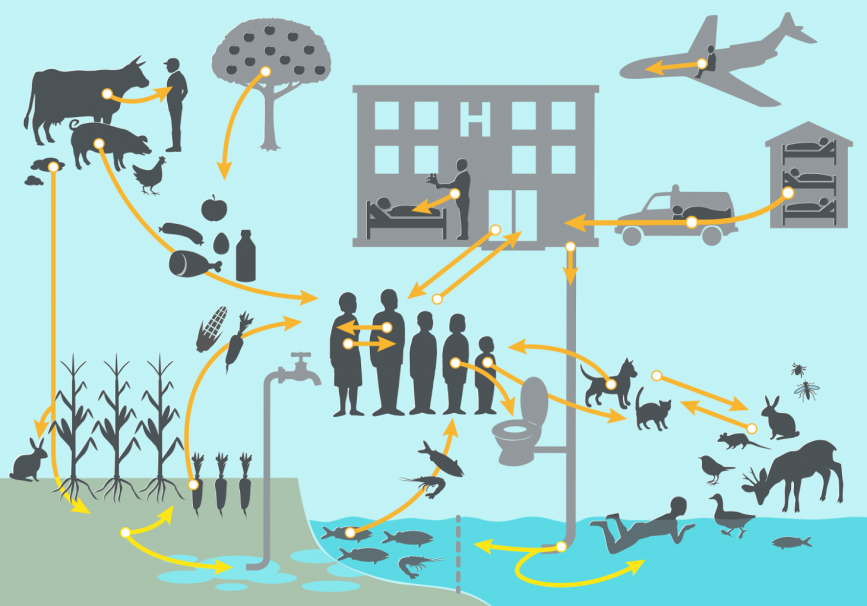
Resistant bacteria can spread in a number of ways. Person-to-person transmission generally results from contact. Moreover, resistant germs can be transferred from animals to humans and vice versa. In the natural environment, contaminated water can transfer resistant bacteria to food such as fruit and vegetables, and transmission through wastewater is also possible. It is clear from this that the problem affects humans, animals, agriculture and the environment. Furthermore, antibiotic resistance does not stop at national borders and can spread anywhere in the world. Accordingly, an integrated approach to the problem – the One Health approach – is essential.
One strategy, eight fields of activity
In 2015, the Federal Council adopted the Strategy on Antibiotic Resistance (StAR). Subsequently, the Federal Office of Public Health (FOPH), Federal Food Safety and Veterinary Office (FSVO), Federal Office for Agriculture (FOAG) and Federal Office for the Environment (FOEN) were mandated to work together to implement the strategy. The FOPH is the lead agency, and implementation is taking place in conjunction with the Cantons and other stakeholders.
The strategy aims to ensure that antibiotics do not lose their efficacy in the long term. Implementation includes a raft of measures that have been divided into eight fields of activity. For example, identifying emerging resistance, taking and adapting immediate action and, indirectly, measuring the long-term effects of the measures that have been implemented requires a comprehensive data survey (the “Monitoring” field of activity). But the public also needs to be more aware of how to use antibiotics correctly (“Information and education” field of activity).
Working together to combat resistance
Taking a systematic approach to combating antibiotic resistance puts all major stakeholders under an obligation. Specialists in healthcare, science and the economy face the challenge of monitoring antibiotic consumption and emerging resistance in human and veterinary medicine, and reducing use to a necessary minimum. The key to overcoming the challenge is to ensure that patients, doctors, vets, etc. share a basic understanding of how to use antibiotics correctly.
This will require information and training on selecting and dosing antibiotics correctly, clear guidelines on when antibiotics can be administered, and low-cost tests that can quickly identify whether viral or bacterial infection has occurred. Hospital hygiene and measures to prevent infection will remain key. It should thus also be possible to reduce antibiotic consumption by taking preventive action, as is illustrated by successful efforts to improve animal hygiene and the conditions under which livestock is kept, or, in human medicine, efforts to improve hygiene in hospitals.
Finally, research efforts need to be ramped up. With this in mind, National Research Programme 72 funded by the Swiss National Science Foundation (SNSF) aims to deliver fresh knowledge about how resistance develops and spreads or to develop new antimicrobials or faster diagnostic tests. Although NRP 72 is not a StAR measure per se, it will play a key role in the success of the One Health approach.
More information on the nationwide Strategy on Antibiotic Resistance can be found at www.star.admin.ch
Umsetzungsbeispiele der Strategie Antibiotikaresistenzen (StAR)
• Im «Swiss Antibiotic Resistance Report» werden seit 2013 die Daten über die Antibiotikaresistenzlage und den Einsatz von Antibiotika in der Human- und Veterinärmedizin gemeinsam publiziert. Der ganzheitliche Ansatz ermöglicht einen besseren Vergleich der erhobenen Daten zwischen den beiden Überwachungsnetzen (siehe anresis.ch in der Humanmedizin und das Monitoring des BLV bei Nutztieren und Fleisch in der Veterinärmedizin).
• Die Schweizerische Gesellschaft für Infektiologie hat in Zusammenarbeit mit der Schweizerischen Gesellschaft für Mikrobiologie und Swissnoso (Nationales Zentrum für Infektionsprävention) nationale Verschreibungsrichtlinien für den Humanbereich publiziert. Sie sollen im Praxisalltag zum sachgemässen Einsatz von Antibiotika beitragen. In einem weiteren Schritt geht es darum, die Richtlinien in Spitälern und Hausarztpraxen bekannt zu machen und deren Umsetzung zu fördern.
• Analog werden auch Vorgaben für den Veterinärbereich erarbeitet oder überarbeitet. Die Tierarzneimittelverordnung (TAMV) regelt unter anderem die Abgabe von Antibiotika in der Landwirtschaft und stellt damit sicher, dass Wirkstoffe bedarfsgerecht und zielgerichtet eingesetzt werden. Bei der Revision dieser Verordnung im Jahre 2016 wurde ein klarer Fokus auf die Anwendung von Antibiotika gelegt und zum Beispiel die Abgabe von kritischen Antibiotika für Nutztiere auf Vorrat eingeschränkt.
• Im November 2018 startete der Bund eine nationale Sensibilisierungskampagne, welche die Bevölkerung auf die Problematik aufmerksam macht. Die Verantwortlichen von StAR führen zudem die World Antibiotic Awareness Week auch in der Schweiz durch (jeweils im November).
• Um Patientinnen und Patienten über den korrekten Umgang mit Antibiotika hinzuweisen, haben pharmaSuisse, die Verbindung der Schweizer Ärztinnen und Ärzte (FMH), die Schweizerische Zahnärzte-Gesellschaft (SSO) und das BAG gemeinsam ein Faktenblatt entwickelt, welches in Arztpraxen und Apotheken abgegeben werden kann. Dieses ist in 10 Sprachen erhältlich und kann zusammen mit einem Erklärungsvideo, Post-its und Poster auf der Website www.antibiotika-richtig-einsetzen.ch bezogen werden.
• Seit Februar 2016 verbietet das BLW aufgrund der Gefahr der Resistenzbildung den Einsatz des Antibiotikums Streptomycin im Kernobstbau. Die Anwendung des Antibiotikums fördert die Resistenzbildung in der Umwelt und verunreinigt Honig.
Weitere Informationen zur Nationalen Strategie Antibiotikaresistenzen finden Sie hier.