Exercise as therapy: still great potential in Switzerland
Jun. 2022Exercise
In Switzerland, exercise has been used infrequently to date as therapy for people with non-communicable diseases, mental illness or addiction problems, although it is actually an effective treatment. The Federal Office of Public Health (FOPH) wants to see exercise as therapy become a more established part of healthcare provision.
Non-communicable diseases (NCDs) are steadily on the rise in our society as a result of increasing life expectancy, but also due to lack of physical activity. This trend is not without its consequences: an estimated 80 percent of health costs in Switzerland are caused by NCDs and mental illness.* Working with partners, the FOPH has therefore drawn up the “National Strategy for the Prevention of Non-Communicable Diseases” (NCD Strategy). In all three action areas of the strategy, promoting exercise is a key measure, since physical activity is clearly an important prevention factor for the development of NCDs. But exercise also has a the rapeutic effect: one aim of the NCD Strategy is to establish exercise as a form of treatment in healthcare provision.
On behalf of the FOPH, re searchers at the Zurich University of Applied Sciences (ZHAW) in Switzerland and other selected countries have studied whether, and if so how, exercise can be used as a therapeutic intervention. From their findings, they have derived recommendations for action for Switzerland.
Exercise as therapy not yet widespread
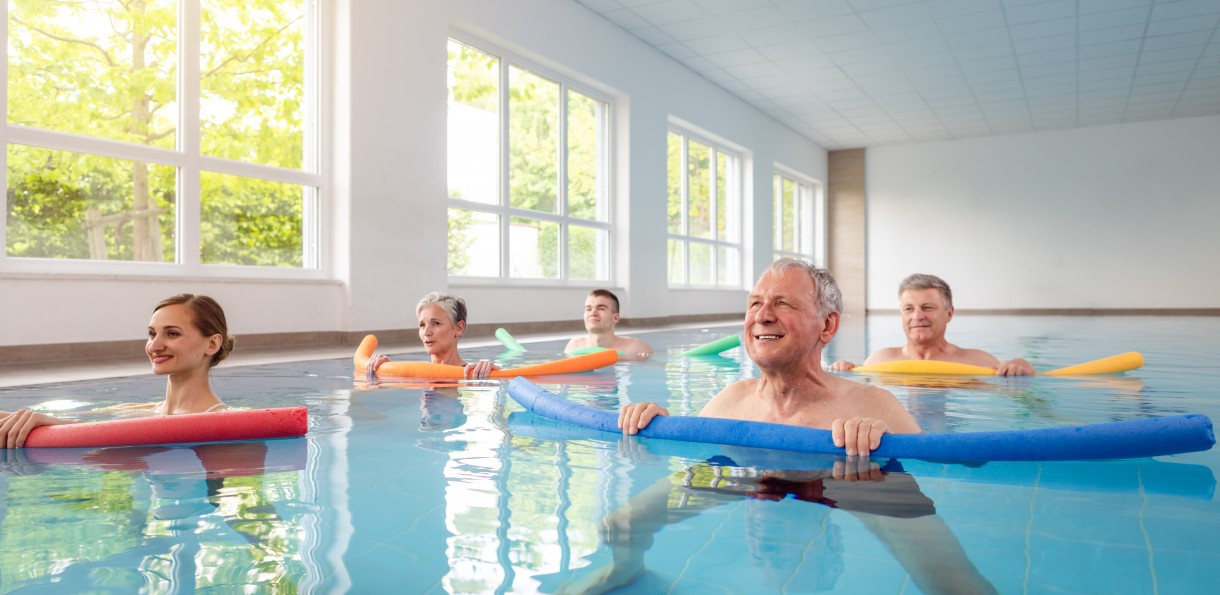
Exercise is considered to be an effective treatment for non-communicable diseases such as cancer, cardiovascular diseases, diabetes, obesity, mental illness, etc. Since exercise courses often take place in groups, this increases social integration, which has a further positive impact on wellbeing. Exercise as therapy poses a challenge because – in contrast with drug treatment – it requires active input from the patients. Exercises also need proper instruction, which means that the professionals who conduct exercise pro grammes require specific training. Specialist courses already exist, Swimming for mobilisation – therapeutic exercise programmes also increase social integration because they often take place in groups for example those run by the Swiss Association of Professionals in Adapted Physical Activities (ASPAPA) or the Schweizerischer Verband für Gesundheitssport & Sporttherapie (SVGS).
Exercise as a therapeutic intervention is not yet widespread in clinical practice in Switzerland, as is apparent from the final report issued by the ZHAW. Although most exercise interventions in NCDs are part of structured rehabilitation programmes covered by basic health insurance, exercise is still not deliberately prescribed to everyone following such pro grammes.
Initiatives for comprehensive implementation
Based on these findings, the ZHAW researchers have drawn up recommendations, including the formation of the umbrella organisation “Exercise is Medicine (EIM) Switzerland”, which is designed to prepare the ground for establishing exercise as therapy in healthcare provision. As well as the FOPH, therapeutic and medical professional associations, educational institutions and other stake holders are responsible for EIM Switzerland. The umbrella organisation aims to bring these stake holders together and jointly address the promotion of exercise as therapy. One of the tasks of a joint EIM concept is to produce a list of indications, establish guide lines and develop an exercise prescription.
Other recommendations for action include the establishment of appropriate funding options as part of basic health insurance and the development of guidelines for the professionals concerned.
Projects that promote therapeutic exercise courses
Health Promotion Switzerland supports various projects involving exercise therapy:The pilot project “Pas à Pas” [step-by-step] (PAP+) is aimed at those who suffer from NCDs, or those who do not exercise enough and are therefore at risk of developing an NCD, with the aim of systematically integrating exercise as a measure for NCD prevention. Another project of Health Promotion Switzerland is “BeFit – fitness for those with Ankylosing Spondylitis”. Sufferers are offered an exercise therapy programme designed to preserve their independence and quality of life.
Other initiatives include the “Diafit” project run by Diabetes Switzerland: a structured exercise programme specifically for patients with glucose intolerance.The aim is to prevent, or delay, the development of type 2 diabetes mellitus and to enable sufferers to lead a healthier lifestyle.
* Wieser et al. 2014. Die Kosten der nichtübertragbaren Krankheiten in der Schweiz.
Links
- Final report of ZHAW (in German)
- FOPH factsheet (in German)
- Interface report “Élaboration de profils de compétences dans le domaine de l’activité physique comme moyen thérapeutique APMT) en Suisse”, 2022 (in French)
- Research reports on physical activity and weight (FOPH; in German)
- Association Suisse des Professionnels en Activités Physiques Adaptées (ASP-APA, in French)
- Sport & Exercise Medicine Switzerland (SEMS; in German)
- Schweizerischer Verband für Gesundheitssport & Sporttherapie (SVGS, in German)
- Pas à Pas (in French)
- «BeFit» (Gesundheitsförderung Schweiz)
- Weitere von Gesundheitsförderung Schweiz geförderte Projekte
- BeFit (Health Promotion Switzerland; in German)