

Progress in suicide prevention in Switzerland
Dec. 2022Suicide prevention
Leitartikel. An interim review of the Suicide Prevention Action Plan: the action plan was launched in 2016 with the objective of reducing the number of suicides and attempted suicides in Switzerland. What’s its current status? Where has progress been made? spectra takes a look at suicide prevention in Switzerland.
Suicide is a serious problem, both globally and in Switzerland. Suicide causes more deaths globally than malaria or breast cancer, for example. According to the World Health Organization (WHO), 700,000 people lost their lives to suicide in 2019. This makes suicide the fourth most common cause of death among men aged 15 to 29 worldwide; among women of the same age, suicide ranks third.
Switzerland is affected too. Suicide rates have been in decline in this country since the 1980s, yet even today roughly three people die in Switzerland every day as a result of suicide, 75 per cent of them men. Suicide is one of the most common causes of premature mortality (measured in potential years of life) after cancer and cardiovascular diseases. Moreover, it always affects the individual’s family and friends.
Suicidality can affect anyone
Suicidality, i.e. suicidal thoughts and behaviour, can affect each and every one of us, whether man or woman, old or young, rich or poor. Suicidality often arises through a complex interaction between different factors such as existential crises, precarious relationships or mobbing, which leads to escalation. Suicidality is a human reaction to enormous suffering, and it often goes hand in hand with symptoms of depression. In most cases, though, suicidal people don’t want to die.
Suicide prevention works
This means that suicides can be prevented – by timely, evidencebased measures. It is important for all parts of society to be included: healthcare, social services, education, civil engineering and the police. In 2016 the federal government and the cantons joined forces with the Health Promotion Switzerland foundation and many other players to develop the Suicide Prevention Action Plan at the behest of the Swiss Parliament with the objective of providing the players in this field with a shared orientation framework.
The action plan aims to make a contribution to reducing suicidal actions. The objective is to achieve a 25 per cent reduction in the suicide rate in Switzerland by 2030 (compared with 2013). The action plan comprises ten objectives and 19 key measures. Many actors are involved in the individual key measures, and it is often possible to build on existing activities. The FOPH supports the implementation of measures by performing networking and coordination tasks and providing knowledge management.
Five years after the action plan was launched, the FOPH commissioned a study to produce an interim assessment. Infras, a research and consultation company, subsequently analysed the status of activities in Switzerland, talked to the actors and developed recommendations.
Suicides can be prevented – by timely, evidencebased measures. It is important for all parts of society to be included: healthcare, social services, education, civil engineering and the police.
There is still a lot to be done
The interim assessment report shows that major progress has been made in some areas of the action plan, and in these areas, such as those linked to the promotion of mental health in general, the level of attainment is high. In these areas there are nationally established actors and many cantons are participating. Nearly all the cantons, for example, have an action programme with an emphasis on increasing resources, and there are many online platforms in Switzerland that provide information on mental health, publicise sources of assistance and also address the topic of suicidality.
Conversely, there are objectives for which only isolated initiatives could be identified and for which the national level of attainment was evaluated as low. This applies particularly to the aim of reducing the availability of means and methods for committing suicide, aftercare for surviving relatives, research and data. This final aspect is one of the reasons why the interim status analysis was not able to provide a comprehensive evaluation in the form of an impact analysis.

Tabelle 1: Stand Umsetzung Nationaler Aktionsplan Suizidprävention (pro Handlungsfeld) Grafik anzeigen
Outlook for the action plan
Where does the action plan go from here? The FOPH discussed the findings of the report, future cooperation and task allocation with selected actors (core group). On the basis of this exchange the core group defined its involvement in suicide prevention for the period 2022–2024 in September 2022 (see Table 1).
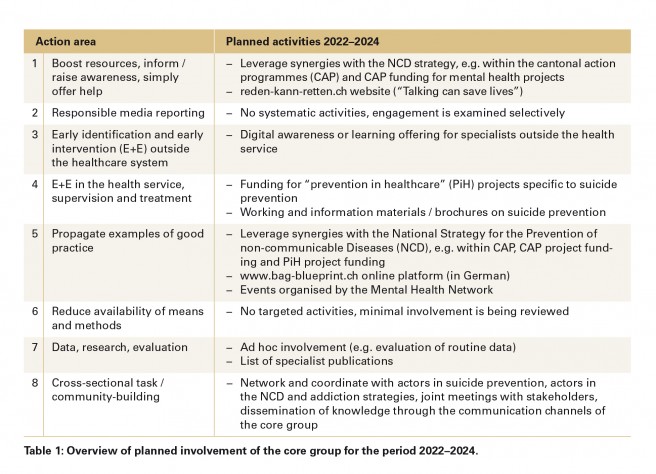
Table 1: Overview of planned involvement of the core group for the period 2022–2024. view graphic
Do you need help or advice?
Children and young adults
Pro Juventute
Telephone (around the clock) and SMS: 147
Mail and chat: www.147.ch
Adults: Dargebotene Hand / Sorgentelefon
Telephone (around the clock) and SMS: 143
Mail and chat: www.143.ch
Further information
www.reden-kann-retten.ch
(in German, French or Italian)


